


Shipping fine art internationally involves two distinct layers of complexity: the physical logistics of the journey and the regulatory control at the border.
Once an aircraft lands or a container is unloaded, the shipment transitions from logistical movement to legal compliance. At that moment, the focus shifts from vibration control and crate design to classification, valuation, and documentation. A single error in this data can delay release for days, potentially triggering storage charges, reclassification duties, or, in worst-case scenarios, seizure.
Understanding these protocols removes uncertainty. This article looks at the full lifecycle of shipping artwork internationally, customs regulations for art, and the clearance process from classification to inspection.
The Foundation: Preparation Before the Border
Successful customs clearance begins long before the shipment lands, during the preparation phase.
To ensure a smooth entry, the artwork must meet the physical standards required for air or ocean freight. Museum-grade packing and custom crating serve a structural purpose, ensuring that the artwork arrives at the port of entry intact and inspection-ready.
Documentation preparation occurs simultaneously. Commercial invoices, condition reports, and export filings are often transmitted electronically while the shipment is still in transit. A pre-clearance approach minimizes idle time on the ground. In the modern customs workflow, documentation review precedes physical inspection.
Related Reading: The Gallery’s Guide to Choosing a Trusted Art Transport Partner
The Regulatory Framework (HTS Chapter 97)

When importing art to the USA, the governing system is the Harmonized Tariff Schedule of the United States (HTSUS). Original works of art fall under HTS Chapter 97, which generally allows duty-free entry. It includes:
- Paintings and drawings executed entirely by hand (HTS 9701)
- Original prints produced from plates created by the artist (HTS 9702)
- Original sculptures and limited castings (HTS 9703)
While often described as duty-free, this exemption requires careful interpretation.
The artwork must qualify as an original work under strict definitions. Decorative objects, designer furniture, or mass-produced pieces usually fall under different classifications that carry duty. If classification is ambiguous, Customs and Border Protection (CBP) may reclassify the item. Correct identification of the HTS code is critical, as misclassification remains a common cause of delays.
Frames introduce another layer of scrutiny. If a frame is considered disproportionately valuable relative to the artwork, it may be classified separately and become subject to duty itself.
Related Reading: Expert Fine Art Shipping Methods Only Professionals Use
Formal Entry, Bonds, and the Structure of Importing Art
The value of the shipment determines the complexity of the entry. While shipments valued under $2,500 may qualify for informal entry, most fine art international shipments exceed that threshold and require formal entry.
Formal entry requires:
- Filing through a licensed broker via the Automated Commercial Environment (ACE)
- A Customs Bond guaranteeing payment of duties and fees
- Accurate declaration of transaction value
The transaction value must reflect the actual price paid for the artwork. Declaring insured value instead of transaction value can trigger automated review systems. A Customs Bond may be issued as a Single Entry Bond for occasional importers or as a Continuous Bond for frequent shippers.
Customs brokerage for fine art requires familiarity with both tariff classification and the art market’s valuation structures. The two intersect frequently.
Valuation: Insurance vs. Customs Declaration
A common point of confusion is the difference between the value declared for shipping insurance and the value declared for customs.
- Customs Value: Based on the Transaction Value (price paid).
- Insurance Value: Based on the replacement or appraisal value.
These two numbers often differ, but they must be reconcilable. When arranging fine art shipping insurance, it is critical to understand that Customs and Border Protection (CBP) may review insurance documents to verify that the declared transaction value is honest.
Discrepancies between a high insurance value and a low customs value can trigger audits. Arrow Express helps clients align these figures to ensure full coverage without inviting regulatory scrutiny.
Related Reading: Fine Art Logistics vs. General Freight (And Why It’s Worth Choosing a Specialist Shipper
The Hidden Costs of MPF, HMF, and Entry Fees
While the duty on original art may be zero, administrative costs still apply.
Merchandise Processing Fee (MPF)
The Merchandise Processing Fee applies to most formal entries. It’s calculated as a percentage of the shipment value, subject to minimum and maximum thresholds. For high-value artwork, the MPF often reaches its maximum cap, effectively becoming a fixed entry cost.
Harbor Maintenance Fee (HMF)
If the artwork enters via ocean freight, the Harbor Maintenance Fee applies. It’s calculated at 0.125 percent of the cargo value and has no maximum cap. For high-value sculpture or exhibition shipments moving by sea, the uncapped structure requires budget planning.
Documentation as the Core of Compliance
The commercial invoice serves as the legal foundation of the shipment. To ensure smooth processing, it must include:
- Artist name
- Title
- Medium
- Year of creation
- Accurate transaction value
- Clear distinction between the country of origin and the country of export
Country of origin denotes the location where the artwork was created, which may differ from the country of export. Errors in origin declarations are a frequent trigger for review.
When exporting from the United States, Electronic Export Information (EEI) must be filed through AESDirect for shipments valued above $2,500. Modern customs clearance is digital-first. Data transmission through ACE and ABI systems determines whether the shipment moves smoothly or is flagged for review.
What Happens During a Customs Inspection?

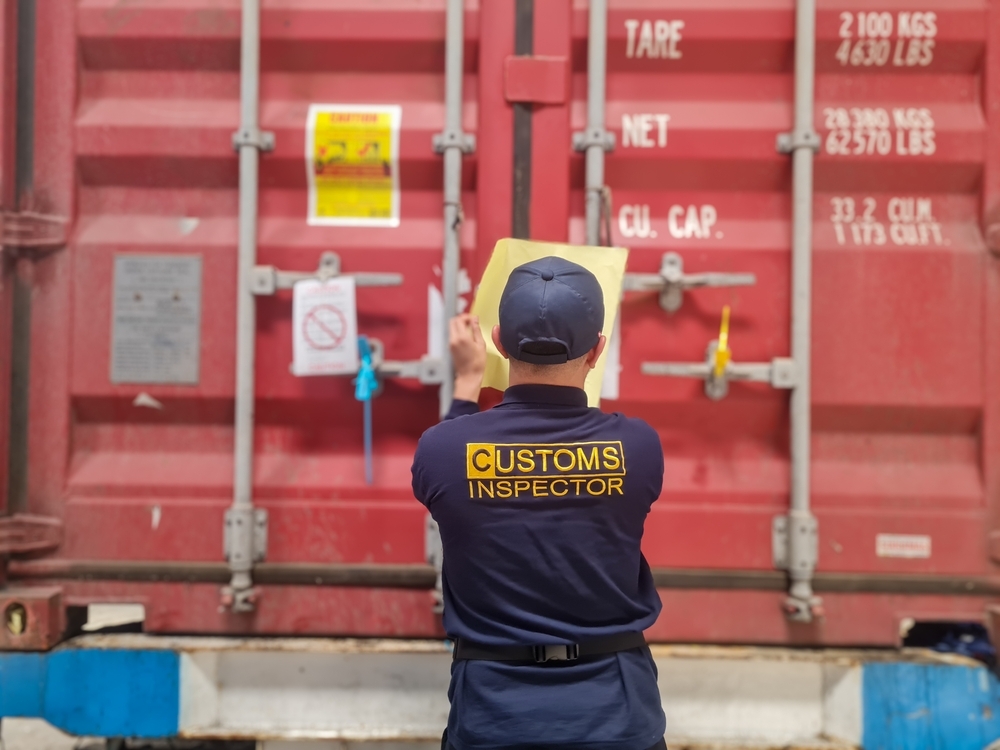
Despite digital systems, physical inspection remains central to enforcement. In major gateways such as JFK International Airport, inspections take place at a Centralized Examination Station (CES).
There are three typical inspection levels:
- Non-Intrusive Inspection (NII/VACIS): Gamma-ray scanning of the crate without breaking the seal.
- Tailgate Examination: Visual inspection after opening the cargo door.
- Intensive Examination (CET): Full opening of the crate and physical handling of contents.
When an intensive exam occurs, proper packing becomes essential. After inspection, museum-grade packing must be restored to maintain structural integrity. Delays typically arise from unclear documentation or data mismatches rather than the inspection itself.
The Final Mile from Port to Plinth
Clearing customs is only the gateway. The final mile, getting the crate from the airport to the client’s wall, is where physical risk re-emerges.
Once released, the cargo must be retrieved by a specialized team, not a general courier. A generic trucking company may not have the experience necessary to maintain the integrity of the shipment after a long flight.
Our white-glove delivery services ensure a professional handover. We coordinate with the customs broker to pick up the cargo the moment it’s released, transport it to the final destination, and handle the uncrating and debris removal. The chain of custody remains unbroken from the international flight deck to the final installation.
Related Reading: The Importance of Custom Crating for Safe, Stress-Free Shipping
Temporary Imports: ATA Carnet and Temporary Admission
For galleries and museums, permanent importation is often unnecessary.
The ATA Carnet functions as a passport for goods. It allows temporary import without paying duties or taxes, provided the artwork exits the country within the permitted period, usually one year. Carnets require strict adherence to the itinerary, physical stamping at every entry and exit, and accurate reconciliation upon re-export. Failure to obtain a required stamp can result in a full duty assessment.
Restricted Materials: CITES and Fish & Wildlife
If an artwork incorporates protected materials such as ivory, rosewood, tortoiseshell, or certain feathers, additional regulation applies. These items fall under CITES and, in the U.S., the jurisdiction of the Fish and Wildlife Service.
Requirements may include USFWS Form 3-177, export and import permits, and entry through a designated port. Processing can take 60 days or longer. Identifying CITES exposure during the pre-shipment assessment prevents costly border complications.
Bonded Storage and Safe Staging
Sometimes, a shipment arrives before the destination is ready, or a complex customs issue requires time to resolve. In these cases, the artwork cannot simply sit on the tarmac.
Using secure art storage facilities that are customs-bonded allows the artwork to move out of the airline warehouse and into a climate-controlled environment while still technically being “at the border”. It prevents exposure to temperature spikes in general cargo areas. For clients renovating a property or galleries awaiting an exhibition opening, moving goods into bonded storage offers a safe holding pattern without triggering immediate duty payments.
The Arrow Express Approach to Customs Clearance

Customs clearance is integrated into our international art shipping process from the outset. We file documentation during transit when possible, confirm HTS classifications before departure, and review materials for CITES exposure during assessment.
We also align transaction values with documentation to prevent automated flags. If inspection is required, we supervise where permitted and ensure packing integrity is restored before onward movement.
Our objective is to ensure that the crate moves from aircraft or vessel to the final destination without unnecessary dwell time. When shipping fine art internationally, compliance is inseparable from preservation. The crate protects the object; the documentation protects the movement.
Related Reading: A Comprehensive Guide On How To Ship Fine Art
What Happens If My Artwork Is Held?
A customs hold is typically a request for information. In the data-driven environment of international trade, automated systems often flag shipments for review based on specific triggers, such as a high declared value, a vague description on the commercial invoice, or a random compliance check.
Common reasons for a hold include:
- Valuation Verification: Customs may request proof of payment (wire transfer or credit card receipt) to ensure the declared value matches the transaction.
- Fish and Wildlife Review: If the description mentions bone, shell, feathers, or wood, the shipment may be flagged for a secondary review to ensure no protected species are involved.
- Random CET Exams: Occasionally, a shipment is selected for an intensive Contraband Enforcement Team exam simply as part of standard port security protocols.
When a hold occurs, speed is critical. Arrow Express monitors entry status in real-time. If a flag appears, we intervene immediately by submitting the required evidence, such as artist declarations, detailed material breakdowns, or proof of transaction, directly to the port officers. Proactive management often resolves the hold before storage fees accrue, ensuring the shipment resumes its journey without significant delay.
The Art of Borderless Logistics
The successful movement of art across borders requires a strategy. Every piece of art carries a complex regulatory identity, defined by its materials, age, value, and origin.
For the collector, gallery, or institution, the main risk at the border is uncertainty. By integrating customs brokerage directly with physical logistics, Arrow Express removes that variable. We ensure that the crate protects the object while the documentation protects the timeline.
Whether you’re tackling HTS Chapter 97 duty exemptions or coordinating a complex temporary admission for an exhibition, our team bridges the gap between the world of fine art and the rigorous demands of international trade law.
Article Sources
- U.S. Customs and Border Protection (CBP). Importing into the United States: A Guide for Commercial Importers. Accessed February 11th, 2026
- U.S. Customs and Border Protection (CBP). Tips for New Importers and Exporters. Accessed February 11th, 2026
- U.S. International Trade Commission (USITC). Official Harmonized Tariff Schedule of the United States (2026 Edition). Accessed February 11th, 2026
- U.S. International Trade Commission (USITC). HTS Chapter 97: Works of Art, Collectors’ Pieces, and Antiques. (PDF). Accessed February 11th, 2026
- U.S. Customs and Border Protection (CBP). Filing an Informal Entry for Goods Valued at Less Than $2,500.
- Code of Federal Regulations (CFR). 19 CFR § 128.24 — Informal Entry Procedures.
- U.S. Customs and Border Protection (CBP). Automated Commercial Environment (ACE). Accessed February 11th, 2026
- U.S. Customs and Border Protection (CBP). Bonds: How are Continuous and Single Entry Bond Amounts Determined? Accessed February 11th, 2026
- U.S. Customs and Border Protection (CBP). User Fee — Merchandise Processing Fees (MPF). Accessed February 11th, 2026
- Federal Register. Customs User Fees To Be Adjusted for Inflation in Fiscal Year 2026 CBP Dec. 25-10. Accessed February 11th, 2026
- U.S. Customs and Border Protection (CBP). Non-Intrusive Inspection (NII) Fact Sheet. Accessed February 11th, 2026
- U.S. Customs and Border Protection (CBP). Cargo Examination. Accessed February 11th, 2026
- U.S. Council for International Business (USCIB). What is an ATA Carnet? Accessed February 11th, 2026
- U.S. Customs and Border Protection (CBP). ATA Carnet Frequently Asked Questions. Accessed February 11th, 2026
- U.S. Customs and Border Protection (CBP). Temporary Importation Under Bond (TIB). Accessed February 11th, 2026
- U.S. Fish & Wildlife Service (USFWS). Form 3-177: Declaration for Importation or Exportation of Fish or Wildlife. Accessed February 11th, 2026