


Choosing between fine art movers and a regular moving company comes down to one question: could the piece be replaced? Standard carriers are built to move whole households efficiently. Fine art logistics is built around the custody and control of individual objects. This guide explains the difference and helps you decide which your collection needs.
Key Takeaways
- Standard household movers are structured for volume and speed. Artwork requires custody and control, which is a different operating model.
- Under FMCSA rules, movers’ no-cost liability option, Released Value Protection, covers just 60 cents per pound per item. A 40-pound painting valued at $15,000 would receive $24 under it.
- Fine art movers reduce risk through condition reports, custom crating, hand-loading, and a documented chain of custody.
- A regular mover is a reasonable choice for robust, replaceable pieces. Specialists earn their fee when a piece is fragile, high-value, or irreplaceable.
From the street, a household move and a fine art move look almost identical. A crew arrives, items are wrapped and loaded, and a truck pulls away. What separates them is everything you cannot see from the sidewalk: how each object was prepared, who is allowed to touch it, how it sits inside the vehicle, and what happens if something goes wrong.
If you’re weighing up whether your collection needs specialist art movers, or whether your household moving company can simply add the paintings to the manifest, this guide explains the real differences and how to vet a specialist before you hand over something irreplaceable.
Quick Answer
If you’re moving original artwork, antiques, sculptures, or high-value collections, specialist fine art movers are usually the safer choice. Unlike standard household movers, they use condition reports, engineered packing, custom crating, documented chain of custody, and specialist transit insurance designed specifically for valuable artworks. General movers are often perfectly suitable for replaceable decorative items and mass-produced prints.
| Feature | Fine Art Movers | Regular Movers |
| Condition reports | ✓ | Rarely |
| Chain of custody | ✓ | No |
| Custom crating | ✓ | Usually no |
| Art handlers | ✓ | General crews |
| Transit insurance | Fine art specific | Standard valuation |
| Building COIs | ✓ | Sometimes |
Why Artwork Gets Damaged in Standard Household Moves
A general moving company is built to move entire homes efficiently. Crews are trained to wrap furniture quickly and fill trucks tightly, because empty space in a trailer costs money. None of that is a criticism. It’s exactly what a household move requires. The problem is that artwork punishes those habits.
- Load Pressure: In a consolidated load, boxes and furniture are packed together so nothing shifts in transit. A blanket-wrapped painting in that environment carries the weight of whatever leans against it. Canvas and gesso rarely show that stress straight away. Hairline cracks might appear weeks after delivery, when the claim window has closed.
- Vibration: Over a few hundred highway miles, constant low-level vibration works on stretcher bars and frame joints. A crate designed for art isolates the piece from that movement. A moving blanket does not.
- Handling Frequency. Long-distance household moves often involve cross-docking, where goods are unloaded, held, and reloaded onto different vehicles. Every transfer adds another set of anonymous hands. We’ve written in detail about why a documented chain of custody matters for exactly this reason.
- The Coverage Gap: The no-cost option many customers select to keep the quote down, Released Value Protection, covers 60 cents per pound per item. Full Value Protection is applied by default, but movers can limit their liability for items worth more than $100 per pound unless they are specifically listed on the shipping documents.

What Fine Art Movers Do Differently
A fine art moving company is structured around a different question. A household mover asks how to move everything efficiently. An art mover asks how this one object needs to travel.
- Documentation Before Movement: A professional art move starts with a condition report, a photographic record of each piece before it is touched, in line with museum-sector documentation practice. If anything changes in transit, it is identified at a specific point in the chain rather than discovered at delivery, with no way to determine when it happened.
- Packing Engineered for the Object: Soft wrapping, corner protection, glassine against painted surfaces, travel frames for canvases, and custom crates built to each piece’s dimensions. The goal is for the object to float inside its packaging, isolated from shock and vibration instead of braced against other cargo.
- Hand-Loading and Dedicated Custody: No conveyor belts and no cross-dock warehouses. Pieces are hand-loaded, braced inside the vehicle, and tracked person-to-person from collection to delivery.
- A Single Point of Contact: A specialist art mover assigns one dispatcher who knows the job. When you call, you reach a person who knows your shipment, where it is, and what happens next.
- Insurance Built for High-Value Goods: Specialists arrange all-risk transit coverage based on declared value and supported by the condition report, rather than liability calculated by weight.
Most of the damage we’re asked to prevent comes from ordinary handling by crews who had no idea what they were carrying. Everything we do, from the crate to the manifest, exists so that every set of hands on a piece knows exactly what it is and what it needs.
— Brian Rees, CEO, Arrow Express
Moving Artwork with Your Household Goods?
General carriers and household movers do a good job with the things that can be replaced. For the pieces that cannot, our fine art movers in NYC provide a single point of contact and a documented plan from door to door. Tell us what is traveling, and we will come back with a clear, itemized plan.
When a Regular Moving Company Is Fine
Not every framed object needs a specialist, and an honest art shipper will tell you so. A regular mover is a reasonable choice for mass-produced prints and posters, replaceable decorative pieces, and sturdy contemporary furniture. If a piece could be replaced tomorrow for a known amount, standard handling and standard valuation may be all it needs.
The calculation changes when a piece is one-of-a-kind, when its market value is well beyond the coverage a household mover offers, or when its condition is part of its value, as with antiques and designer furniture. A useful test: would an insurance payout actually cover the full value? If so, a standard valuation may be sufficient. If not, the piece deserves specialist handling.
Moving Art in New York City
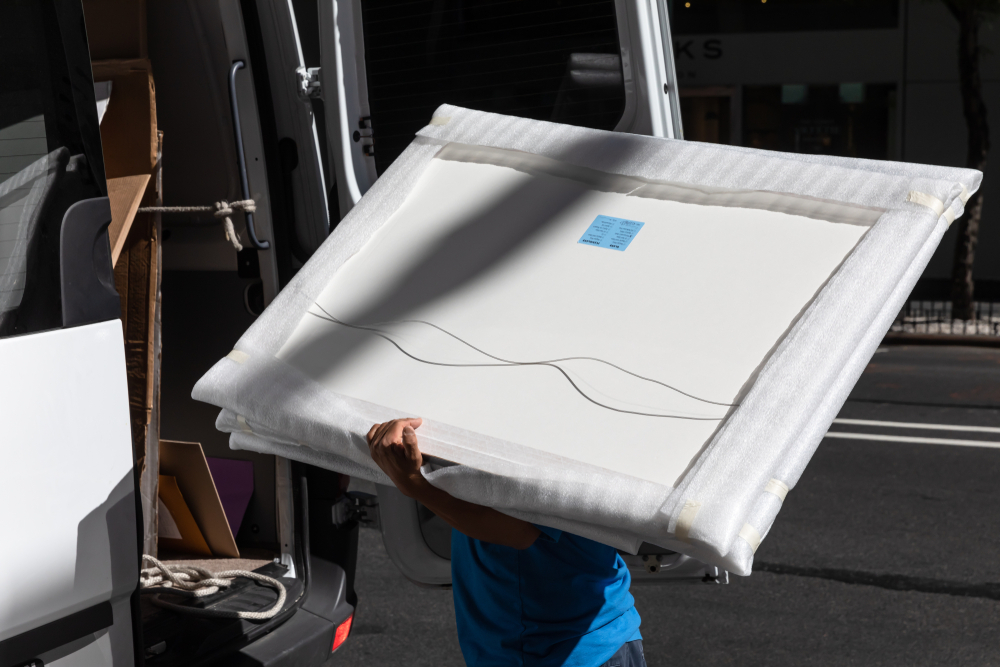
Art movers in NYC deal with a layer of logistics that has nothing to do with distance. Many pre-war co-ops and managed buildings will not let a crew through the door without a certificate of insurance naming the building, issued before move day. Freight elevators must be reserved, often in narrow weekday windows, and some buildings restrict moves to specific hours. Between the truck and the lobby, there’s also a stretch of public sidewalk, which is where a surprising share of damage happens.
Beyond the paperwork, the city itself creates additional planning challenges. Many collections are moved into pre-war brownstones with narrow staircases or through commercial buildings where loading docks and freight elevators must be booked weeks in advance. Experienced fine art movers in NYC coordinate these access requirements before collection day, reducing unnecessary handling and helping deliveries stay on schedule.
A specialist who works in the city every week builds COI paperwork, elevator bookings, and building requirements into the job before the crew arrives. Our guide to fine art shipping in New York covers these building-level requirements in detail, and our local and nationwide collection service handles them as standard.
Case Study: From an Upper East Side Co-Op to Palm Beach
A private collector relocating for the winter needed fourteen pieces moved from an Upper East Side co-op to a residence in Palm Beach, including two large oil paintings and a bronze. The household movers handling the rest of the home were booked; the collector wanted the art handled separately.
The job began with a site survey and condition reports for each piece. Six works needed custom crates, and the paintings traveled in fitted travel frames. Arrow supplied the building’s required COI, booked the freight elevator window, and hand-carried each piece from apartment to vehicle. The shipment traveled as a dedicated run with no transfers, and every piece was unpacked, checked against its condition report, and signed off at delivery.
Related Reading: Inside Custom Wooden Crates: What Protects Artwork During Local, Domestic, and International Shipping?
How to Vet a Fine Art Mover
The difference between a true specialist and a general mover with “fine art” on the website is visible quickly under a few direct questions:
- Who physically handles the piece in transit? Ask whether the handling crew are employees, and who will be in the truck.
- What insurance applies, at what declared value, and what documentation supports a claim?
- Are condition reports produced as standard, or only on request?
- Is crating done in-house, and to what specification?
- Can you handle my building’s COI and freight elevator requirements?
- Can you provide references from galleries or institutions?
Treat vague answers about who does the handling as a red flag, along with any quote dramatically lower than the others. In this field, a price that looks too good usually means the handling is being economized somewhere you cannot see.
Free Guide: The Art of Predictable Shipping
Our complete professional guide to moving fine art: how risk is assessed before anything moves, how the right level of protection is chosen, what New York buildings require, and how liability and insurance actually work in transit. Written for collectors, galleries, and registrars.
What It Costs to Move Fine Art
Cost depends on the size and fragility of each piece, the distance, the crating required, access at both ends, and the value being insured. Custom crating is often the largest single line for fragile works. We have covered realistic cost drivers and ranges in our guide to the cost of shipping art. For a specific number, an itemized estimate based on the actual pieces is more useful than any published range.
Are Fine Art Movers More Expensive?
Usually, yes. The additional cost reflects:
- Condition reporting
- Specialist handlers
- Engineered packing
- Custom crating
- Dedicated transport
- Higher insurance standards.
For high-value artwork, these measures typically cost far less than repairing or replacing a damaged piece.
Who Should Hire Fine Art Movers?
Professional fine art movers are typically used by:
- Galleries
- Museums
- Auction houses
- Interior designers
- Private collectors
- Artists
- Estate managers
- Family offices.
Frequently Asked Questions about Fine Art Movers vs Regular Moving Companies
Below are the questions collectors, galleries, and designers most often ask our art movers in NYC. If yours is not covered, call us, and a person who can answer it will pick up.
Do art movers take on single pieces?
Yes. Single-item jobs are routine for specialist art movers. One painting, one sculpture, or one heirloom receives the same process as a full collection: condition report, appropriate packing, and documented handling from door to door.
Are fine art movers insured differently from regular movers?
Yes, and it is the most important difference. Household movers’ default liability is calculated by weight. Fine art movers arrange all-risk transit insurance based on the declared value of each piece, with condition reports providing the documentation a claim would rely on.
Can household movers refuse to move artwork?
Yes. Some movers exclude particularly valuable artwork, antiques, or unusually fragile items from their standard liability or require them to be declared in advance. Always ask what is and isn’t covered before moving day.
How far in advance should I book art movers in NYC?
As early as possible, once your dates are known. The schedule is usually set by the buildings rather than the mover: COI processing and freight elevator reservations can take longer to arrange than the move itself, especially in managed buildings in New York.
Can art movers pack everything on site?
Yes. On-site packing is standard practice for fine art moves, and mobile packing services bring materials and crating capability to your location, so pieces are protected before they travel anywhere.
Protect the Pieces That Can’t Be Replaced
Whether you’re moving one painting or an entire collection, the safest time to manage risk is before anything leaves the wall.
Our specialists can assess the artwork, recommend the appropriate level of protection, and provide a clear, itemized shipping plan before moving day.
Article Sources
- Federal Motor Carrier Safety Administration (FMCSA). Liability & Protection. November 4th, 2024
- International Council of Museums (ICOM). Standards and guidelines. Accessed July 7th, 2026
- New York City Department of Transportation (NYC DOT). Parking a Truck or Commercial Vehicle. Accessed July 7th, 2026